Body Contouring: What It Can Actually Change, What It Costs, and How to Avoid Paying for Nothing
We have all seen the same pattern. Someone buys a package of body contouring sessions, takes before photos, finishes the last appointment, and then cannot see the difference. The clinic says to wait, the wait passes, and the only thing that changed was the credit card balance. Most of the time the treatment was not fake and the machine was not broken. The problem was that the plan addressed the wrong layer. Body contouring does not remove weight, does not touch visceral fat, and does not tighten loose skin unless tightening is actually part of the plan. Fat, skin, and muscle are three separate problems, and each one has a different tool. This guide walks through what a real consultation should check, which option fits which problem, how results actually show up over time, the aftercare that determines half the outcome, how to screen a clinic, how to build a budget, and the safety issues worth knowing before you sign anything.
First: What Contouring Does and Does Not Do
Non-invasive contouring reduces pockets of subcutaneous fat, the kind you can pinch. It does not lower body weight in any meaningful way, and the scale will barely move. It also does not remove visceral fat around the organs, which is the fat that matters for metabolic health.
That is why the honest framing is "shape," not "weight loss." A clinic that sells contouring as a weight-loss shortcut is selling something the technology cannot deliver, and the disappointment is built into the promise.
It also does not replace skin tightening surgery. If the skin is already loose, removing fat underneath can make looseness more visible, not less. This is a conversation that should happen before payment, not after.
The Consultation: What a Real Assessment Checks
A proper assessment takes time, uses hands and measurements, and produces a plan rather than a package.
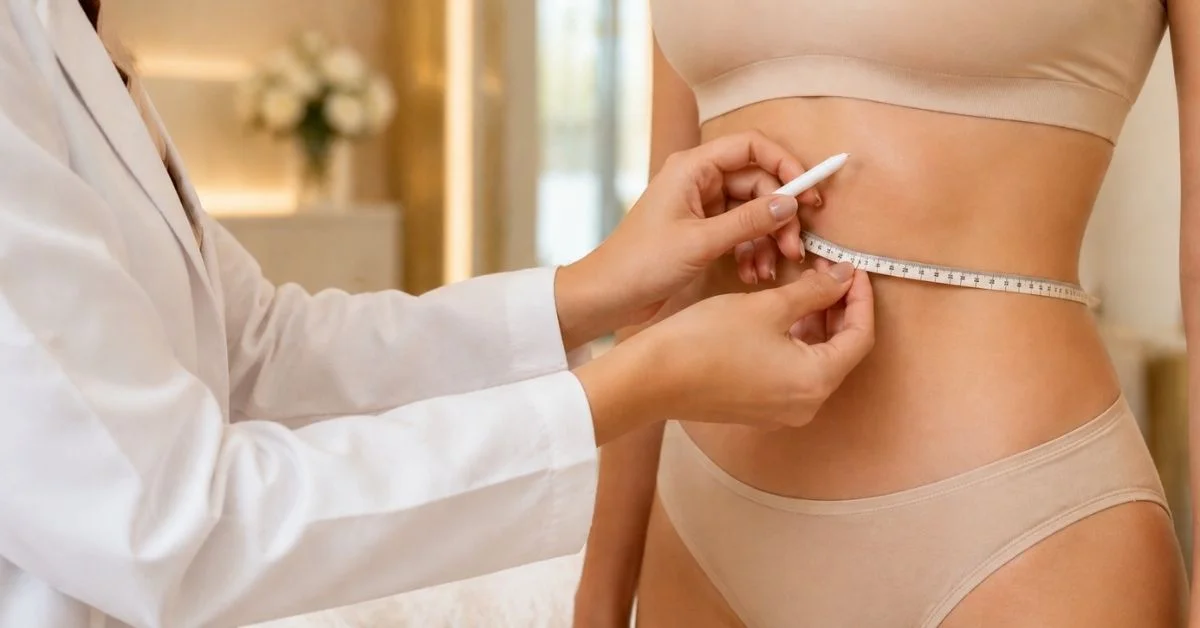
First, pinch thickness. The practitioner should pinch the area and measure the fat layer. If you cannot pinch much, there is not much for a fat-reducing device to work on, and the result will be modest no matter how many sessions you buy.
Second, skin elasticity. Loose skin over a fat pocket behaves differently from firm skin. This determines whether tightening should be added, and whether the realistic outcome is "smaller" or "smoother."
Third, muscle separation and posture. Abdominal wall separation after pregnancy is a structural issue, not a fat issue. Devices marketed for "core" work will not close a separation, and treating it as fat is a waste of money.
Fourth, weight stability. Contouring works best when weight has been stable for a few months. If weight is still moving, the result will be hard to judge and easy to blame on the treatment.
Fifth, health history. Cold sensitivity, circulation problems, nerve conditions, pregnancy or breastfeeding, liver disease (relevant for injectable fat-dissolving treatments), and any history of hernia or recent surgery in the area.
Sixth, the outcome in numbers. "Smaller" is not a goal. "Two centimeters off the waist at eight weeks" is. A clinic that will not put a number on it is not measuring anything.
Choosing the Right Option
Non-Invasive Fat Reduction
The most common approach cools or heats a pocket of fat so the cells break down and are cleared by the body over the following weeks. It suits pinchable, localized pockets — lower abdomen, flanks, inner thighs, under the chin — rather than broad areas.
Key point: one session reduces fat in the treated pocket by roughly a fifth to a quarter, and the change appears over one to three months, not overnight. Multiple areas usually need multiple sessions, and some areas respond better than others.
Skin Tightening
Radiofrequency and focused ultrasound are the two workhorses here. They do not remove fat; they heat deeper layers to stimulate collagen and improve firmness over eight to twelve weeks.
The honest limitation is that non-invasive tightening gives a moderate improvement in mild to moderate looseness. It does not replace a lift. If a clinic promises surgical-level tightening without surgery, that is the moment to ask for before-and-after photos of someone with your starting point.
Injectable Fat Dissolving (Small Areas)
For a small, well-defined pocket — typically under the chin — an injectable treatment can be an option. It requires a series of visits, causes swelling for several days, and should only be done by someone who can assess the anatomy and handle complications.
Muscle Stimulation Add-On
Devices that contract muscles can improve tone and definition, and they pair reasonably with fat reduction. They do not remove fat. Selling them as a substitute for fat reduction is a common mismatch.
How Results Actually Show Up
Knowing the timeline is what keeps people from quitting too early or being talked into extra sessions they do not need.
Fat reduction: mild swelling and tenderness for a few days, then little visible change for two to four weeks, then gradual change from month one through month three. Final result is usually judged at three months.
Skin tightening: a faint immediate firmness, then real collagen change from six to twelve weeks, with a peak around three months.
If a clinic tells you to judge the result at two weeks, they are setting up either a premature upsell or an excuse.
Aftercare That Determines Half the Outcome
For cooling-based fat reduction: gentle massage of the treated area as instructed, return to normal activity quickly, and expect temporary numbness or a firm feeling that resolves over weeks. Avoid intense heat on the area for a few days.
For heat-based tightening: expect redness and mild swelling, keep the skin hydrated, avoid hot yoga and saunas for a few days, and do not judge firmness in the first two weeks.
For injectables: expect swelling and possible bruising, avoid pressure and massage on the area unless told otherwise, and skip strenuous activity and alcohol for the first couple of days.
Across all types: hydration matters, weight stability protects the result, and compression garments should be used only if specifically instructed — not because someone handed you one.
Screening a Clinic in Ten Minutes
Ask these and the answers tell you most of what you need.
First, who performs the treatment, and what is their training? The person holding the handpiece is the treatment.
Second, is the device the real one, and how many cycles or shots am I getting? Some low prices assume the minimum setting, which is not enough to produce a change.
Third, will you show me before-and-after photos of someone with my starting point? Not a model, not a filtered image.
Fourth, what is the plan if I see no change? Is there a revision policy, and is it in writing?
Fifth, what are the known risks for this specific device, and how often do they occur here? Anyone who says "no risks" is not being straight with you.
Sixth, how many follow-up visits are included, and are they actually scheduled?
Budget Planning
Split the money into three parts. First, the consultation and any measurement or imaging, which is where the real information comes from. Second, the treatment itself, priced per area and per session — not per "package." Third, a reserve for the second round that many people genuinely need, because one session rarely finishes a pocket.
Two habits save real money. Get the price per area per session in writing so packages cannot hide the unit cost, and refuse to buy a large package before you have seen how your body responds to the first session.
The classic traps: a low price for "one area" that means one small applicator cycle; a package that expires quickly; add-on tightening sessions sold mid-treatment as "necessary"; and a consultation that turns into a same-day pressure sale with a discount that ends today.
Safety Points Worth Knowing
Paradoxical adipose hyperplasia is a real, documented risk with cooling-based fat reduction: the treated area grows firmer and larger instead of smaller. It is uncommon but not rare enough to ignore, and it is more likely with larger applicators and certain areas. Ask directly how the clinic handles it, because the answer reveals whether they have seen it.
Cooling treatments are not appropriate for people with cold-related conditions such as cold agglutinin disease, and injectable fat dissolvers are not appropriate with certain liver conditions or during pregnancy.
Contouring is not a treatment for obesity, and it does not improve metabolic markers.
Numbness, lumps, asymmetry, and burns from heat-based devices are all possible. Serious complications are uncommon in trained hands and much more common in untrained ones, which is why "who performs it" is the first question, not the last.
Price Reference Table
Rough market ranges, not quotes. Actual pricing depends on the number of areas, applicator size, session count, and provider.
What People Get Wrong
Buying contouring as a weight-loss solution.
Treating a skin looseness problem with a fat-reduction device.
Buying a large package before seeing how one session responds.
Judging the result at two weeks.
Ignoring a firm lump that appears weeks after cooling treatment instead of calling the clinic.
Assuming the price covers the number of cycles actually needed.